
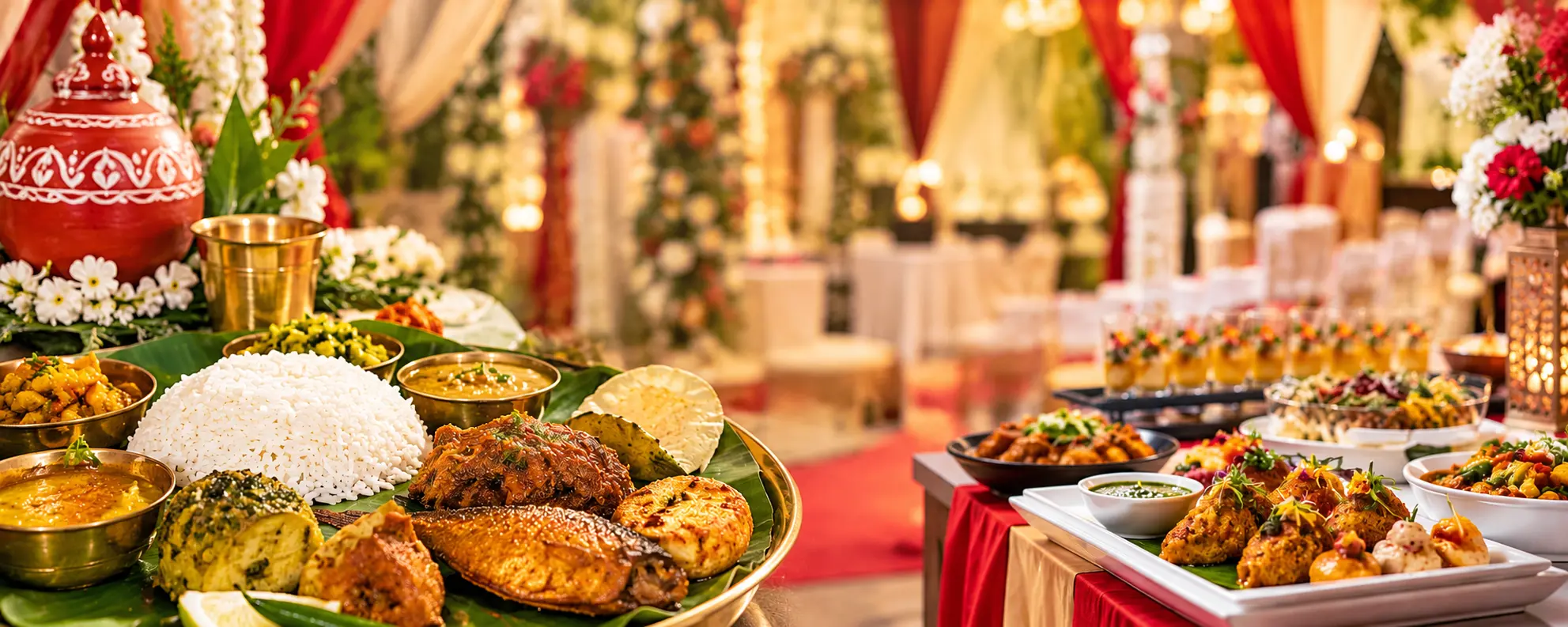
Bengali Wedding Menu Ideas: From Traditional Biye Bari Food to Modern Celebrations
A Bengali wedding is remembered in many ways.
The rituals. The music. The flowers. The sarees and panjabis. The laughter around the dining table.
And, very often, the food.
Ask someone about a wedding they attended years ago and there is a good chance they will remember a particular dish. The crispness of a bhetki fry. The aroma of pulao. The richness of kosha mangsho. The sweetness of mishti doi.
That is what makes planning a Bengali wedding menu slightly different from planning an ordinary party menu. Food is not simply something served between ceremonies. It is part of the hospitality.
But a traditional Bengali wedding menu does not have to mean serving every dish that comes to mind.
A well-planned menu is about balance.
What is a traditional Bengali wedding menu?
A traditional Bengali wedding meal usually moves through several stages rather than presenting everything at once.
Depending on the family, occasion and region, the meal may include fried starters, vegetarian preparations, fish, prawns, meat, rice, chutney and sweets.
A familiar combination might include:
- Luchi or kachuri
- Cholar dal
- Begun bhaja
- Shukto
- Aloo posto
- Dhokar dalna
- Bhetki fry
- Bhetki paturi
- Doi maach
- Chingri malaikari
- Bengali pulao
- Kosha mangsho
- Tomato or date chutney
- Papad
- Mishti doi
- Sandesh
- Rosogolla
- Payesh
Not every wedding needs all of them.
That is an important point.
Current Kolkata wedding-menu content often follows this same traditional foundation, while adding contemporary dishes and live counters.
The Bengali wedding menu is changing
Modern Kolkata weddings have not abandoned Bengali food.
Instead, many families are combining familiar dishes with newer formats.
A wedding may have bhetki paturi and kosha mangsho alongside a live chaat counter. A traditional pulao may share the buffet with a small continental section. Bengali sweets may sit beside desserts from other cuisines.
The idea is not to replace tradition.
It is to give guests a little more choice.
How to build a balanced Bengali wedding menu
Begin with the list of guests.
The menu that needs to be prepared for 100 guests is not the same menu that has to be prepared for 500 guests.
Consider the occasion next.
An old-fashioned wedding in the afternoon could require an entirely different menu than a modern day reception.
Finally, take into account the people eating the menu.
The food will matter less if there are more older relatives among the guest list.
Modern food can be included if the majority of the guests are young.
How many dishes are enough?
There is no magic number.
More dishes do not automatically mean a better wedding meal.
A buffet with 25 items can leave guests confused while a carefully chosen menu of 12–15 dishes can feel generous and complete.
A useful way to plan is by category.
Starters
Choose two or three.
Fry fish, vegetable chop, mochar chop, chicken starter or even a special Bengali snack could be considered depending upon the occasion.
Vegetarian course
Choose two or three dishes with different textures and flavours.
For example:
- Shukto
- Cholar dal
- Begun bhaja
- Aloo posto
- Dhokar dalna
Fish
One good fish preparation can be enough.
Bhetki paturi, doi maach, shorshe ilish or another suitable preparation can become the centrepiece.
Seafood
Chingri is often treated as a special addition.
The preparation of chingri malaikari is known to all, but the appropriate preparation will depend upon the total menu.
Meat
Kosha mangsho is a classic choice for a non-vegetarian Bengali wedding.
Its slow-cooked character also makes it a dish that benefits from proper preparation rather than simply being added for variety.
Rice
Pulao, basanti pulao or plain rice can be selected according to the dishes that accompany them.
Chutney
Tomato, mango or khejur chutney can provide the sweet-tangy finish.
Desserts
This is where Bengali celebrations have plenty of choice.
Mishti doi, sandesh, rosogolla, payesh, baked rosogolla and seasonal sweets can all work.
What makes a modern Bengali wedding menu?
Modern does not have to mean unfamiliar.
Consider a menu such as:
Welcome: Gondhoraj ghol
Starter: Bhetki fry
Vegetarian: Cholar dal and begun bhaja
Fish: Bhetki paturi
Seafood: Chingri malaikari
Meat: Kosha mangsho
Rice: Bengali pulao
Chutney: Tomato-khejur chutney
Dessert: Mishti doi, sandesh and seasonal payesh
A single live counter could be added if it suits the guest profile.
That is enough to make the experience contemporary without losing its Bengali character.
Seasonal food matters
Bengali food changes with the seasons.
Winter opens up ingredients and flavours that may not make sense in summer.
Nolen gur, for example, brings an entirely different character to desserts and payesh.
Similarly, some fish preparations work better at particular times of the year.
A seasonal menu can therefore feel more thoughtful than a fixed menu used throughout the year.
Think about the sequence, not just the dishes
A good menu should have rhythm.
Heavy dishes should not arrive one after another.
If there are rich starters, keep some of the main course lighter.
If there is an elaborate meat dish, there may be no need for three other heavy gravies.
The same applies to desserts.
Guests should still want the final mishti.
The most important question
Instead of asking:
“How many dishes can we fit into the menu?”
ask:
“What will our guests actually remember?”
This normally results in an improved menu.
In a sense, a Bengali wedding dinner is all about hospitality and generosity. The food needs to be plentiful, but also thought out.
An ideal menu may not be a long one always.
It is the one that, when the familiar is good, the novel is pleasant, and every dish has its place.
Frequently Asked Questions
What are the must-have dishes for a Bengali wedding?
Common choices include cholar dal, begun bhaja, fish preparation, chingri, kosha mangsho, Bengali pulao, chutney and Bengali sweets. The exact menu varies by family and occasion.
What is a traditional Bengali biye bari menu?
A traditional biye bari meal generally combines vegetarian dishes, fish, seafood, meat, rice, chutney and sweets, often served in a particular sequence.
How many dishes should a Bengali wedding menu have?
There is no fixed number. A balanced menu is generally more useful than simply adding more dishes.
What are popular Bengali wedding desserts?
Mishti doi, sandesh, rosogolla and payesh remain popular choices, along with seasonal Bengali sweets.